
ALAND (ÅLAND) PHILATELY
Aland in Russia

As a consequence of the Swedish-Russian war in 1808/09, Sweden lost its Finnish territory to the the Russian Empire including Aland. Zar Alexander I, the then ruler of the Russian Empire, granted Finland which was to be named the Grand-Duchy of Finland autonomy. Therefore postal services of the Grand-Duchy were self-controlled.
With the Russification of the later 19th century until 1917, Aland suffered the same consequences postally as the rest of the Grand-Duchy of Finland culminating in the use of stamps of Russian design
1821
The Aland Mail Route


Letter written on August 23, 1821, in St. Petersburg (Russia). Destination: Warrington (Great Britain).
The letter arrived in London on September 26, 1821. It bears two arrival stamps and a single line reading “GRISLEHAMN.” The letter was transported from east to west via the Aland postal route.
The content is an invoice. FPO (Foreign Post Office) stamp from London, September 26, 1821, and GSE stamp (“G” for device designation; in London, A to G were used, “SE” for September, therefore September 26, 1821). The narrow outer two circles of the stamp indicate that it was stamped in the evening
1908
Stamps with Russian Design


Picture postcard from Mariehamn to Pälkäne. Cancelled in 1908 with a trilingual (Swedish/Finnish/Russian) double-circle postmark with a grid at the top and bottom from Mariehamn/Maarianhamina/Мариехамн.
Front: Mariehamn / View from Badhusparken. (View from the bathhouse park.)
1912
Local Covers

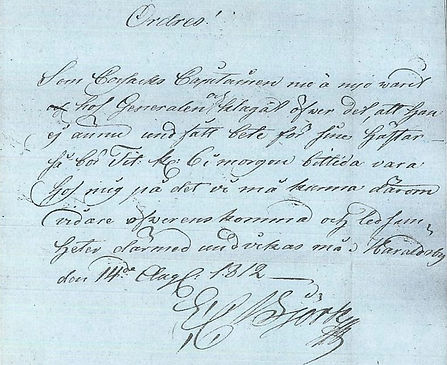
A feather letter written on August 14, 1812, sent from Haraldsby to Palsböle, a distance of approximately 10 km. The letter was addressed to the judicial officer (Expeditions Befallningsmär) and district official of the Crown (Krono Landsmannen), the highly esteemed (Högagdat) Mr. C. Malmsberg. Even under Russian rule, the Swedish designations were initially retained.
The text of the letter reads:
Orders.
Since Captain Corsack was here and complained to the general that he had not yet received fodder for his horses, you are to report to my residence tomorrow morning so that we may reach a further agreement on this matter and thereby avoid any inconvenience.
Haraldsby, August 14, 1812